This site is a resource for tips and tools for excellence in care for women. It is dedicated to happenings at the Women's Health Education Program of Drexel University College of Medicine. WHEP's programming includes innovative education of health professionals, community outreach, community participatory research and networking with like-minded people interested in overcoming gender health disparities.
Provide clear, easy to understand information of complex genetic techniques and normal anatomic changes in pregnancy is a physician literacy skill. Despite the challenge of learning the jargon and concepts, consider how you would discuss this with someone who is a physicist, an engineer or an administrative aide. Getting at the right place where you and the patient are on the same page is an incredibly important skill to work on. This right place might feel too reductionistic or be too 'cartoony' - so it is not the 'right place' for you, rather it is the 'right place' for you patient.
Below is an example of a clear, user friendly tool that is called a decision support instrument. Click on the caption to see the whole tool at the site.
CVS, AMNIO FISH and PCR - For more visuals Here's a picture of a chorionic villus (which when sampling becomes the 'S' of CVS)
Here's a nice example of the use of FISH and PCR (you may have to register your name to watch the short video, but it's worth it!) click here
Here's a patient information sheet on CVS from Medline
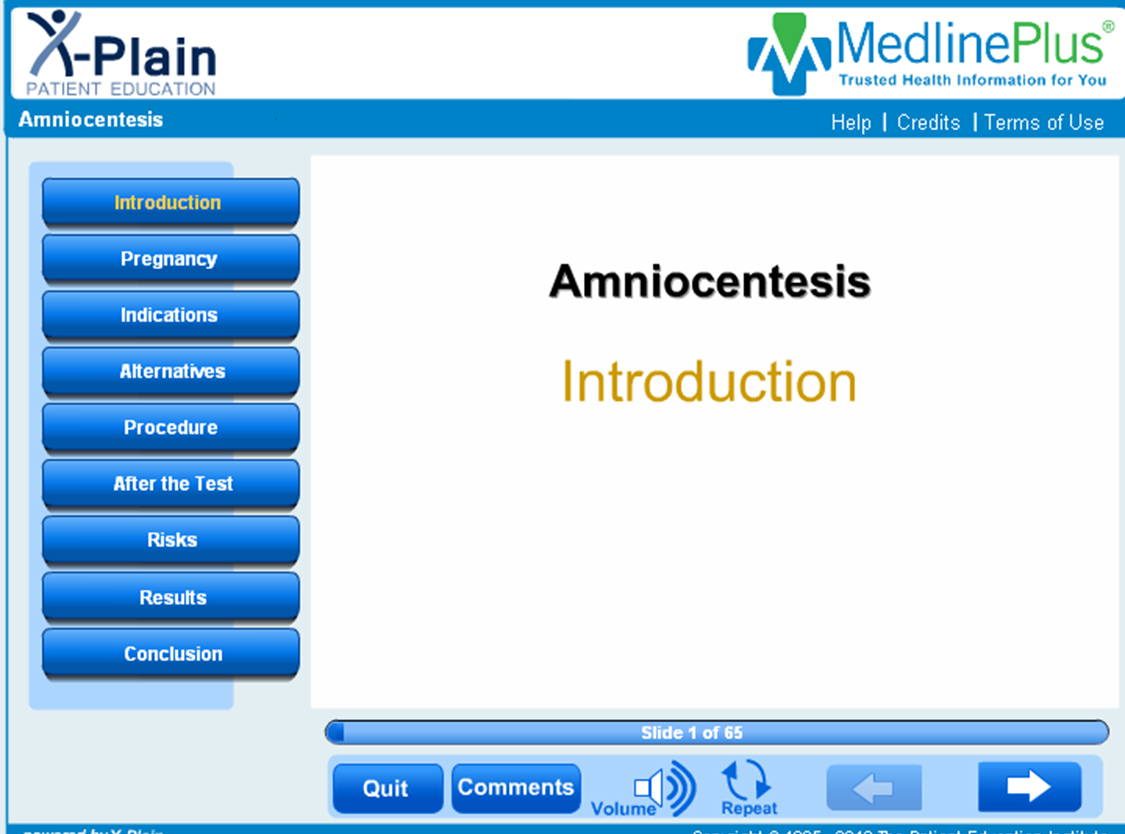
And here is an interactive tutorial on AMNIOCENTESIS
I mentioned in class, the image of the nuchal translucency (you can get to it from here)
Thursday, September 6, 2012
Ischemic Heart Disease and Women
One of the many amazing (and distinguished) cardiologist I am fortunate to know is Dr. Noel Bairey Merz. Read more about her here. She and her colleagues in their 2009 article (see here) posit that the female presentation of disease may be due, in part to ischemia presenting differently in women (as compared to men)
In a rudimentary perspective, ischemia is often viewed as obstruction (due to atheromatous plaques and sticky platelets.)
As the diameter of the vessel becomes more compromised and when demand for blood flow goes up (e.g. exercise), the mismatch of needed blood to tissues and that delivered results in pressure, pain or symptoms. The clogged vessel approach may be true for some people (men and women) but it does not explain why women (with cardiovascular risks and normal catheterizations) respond better to treatment similar to those with obstructive disease. The endothelial response of illness in ischemia, may be in part a reason why women, vs men experience a)no symptoms (yet have disease); b) 'different' symptoms - fast heart rate, GI upset, profound fatigue and c) die at higher numbers than their male counterparts. So here again, we have the opportunity that sex and gender medicine can present inroads to the pathophysiology of ischemic heart disease that is accurate for both women and men - but we are still early in the game. Read more in the article link above and search the blog for other useful resources and stats.
Two of our Drexel Heart Health Medicine experts contributed to this - Dr Katherine Sherif Associate Professor of Medicine and Director of the Center for Women's Health and Dr Ellie Kelepouris, Professor of Medicine, Section Chief of Nephrology and Vice Chair for Medical Education
PrEP is short for Pre-Exposure Prophylaxis of HIV to prevent transmission of disease. Recent studies have demonstrated that a combination medication tenofovir disoproxil fumarate plus emtricitabine (TDF/FTC) and the FDA has approved it's use. Our own, Infectious Disease clinician, Erika Aarons, RN, CRNP, MSN was on the FDA Advisory panel that evaluated and voted upon approval of this new medication. Read the article here. The FDA resport is here.
This news is exciting in that this the first medication combination identified in 30 years that if taken regularly, can result in a 90% reduction in risk of an HIV negative partner acquiring the disease from their HIV positive partner. So, in serodiscordant partners (one with HIV/AIDs, one not) this is an incredible breakthrough.
Here's a few important issues:
*Medicine only was effective at that rate if taken every single day - those who did not have sufficient medication in their blood did not have the same result
*HIV transmission in serodiscordant couples occurs outside of a couple in 25-30% of cases (Donnell 2010; Cohen 2011)
*Estimated cost of daily therapy is likely to be in excess of $10,000/year.
*Lifetime costs (2010 numbers) for HIV treatment is $379,668 (excluding reproductive health related issues)
So PrEP is amazing scientifically, yet does it remain a wish versus a reality? This is a great example of the challenges faced when we address paying for prevention. I wonder how expensive or inexpensive an intervention would need to be to get support to prevent Diabetes?
HIV at the onset was (fairly) quick and (mostly) deadly disease - with the onset of HAART, HIV can become a chronic disease. At the beginning when there was only one or limited agents, medical science had not demonstrated how sneaky the HIV virus can be. It is now known that to combat disease, people often need three types of anti virals to keep the disease from changing and becoming resistant. I think of it as making a corral for a horse with three fences - keeping it within the triangle. If we use one or two or infrequently use the medicines, HIV learns quickly (becomes resistant) and makes the medicine ineffective. Regular medicine use is challenged for any medical illness - HIV is no different. But there are some difference with HIV - CDC estimates that 1 in 5 people have disease and are unaware. So in place where there is a lot of HIV, people ages 11 and up and all people sexually active should have HIV screening as part of their routine evaluation. In the Philadelphia Ujima project, we talk about "Know Your Numbers, Own Your Health."
Perhaps next steps need to be more medical advances resulting in more medicines that decrease the cost of transmission preventing medicines?
Kaiser Family Foundation. www.statehealthfacts.org. Data Source: Centers for Disease Control and Prevention, Division of HIV/AIDS Prevention-Surveillance and Epidemiology, Special Data Request; 2010
Donnell D, Baeten JM, Kiarie J, et al. Heterosexual HIV-1 transmission after initiation of antiretroviral therapy: a prospective cohort analysis. Lancet 2010;375:2092-2098 Cohen MS, Chen YQ, McCauley M, et al. Prevention of HIV-1 infection with early antiretroviral therapy. N Engl J Med 2011;365:493-505
Kaiser Foundation 2012 Fact Sheet on Women with HIV here
Hot Off the Press Aaron, E., Cohen D. Pre-exposure Prophylaxis for the Prevention of HIV
Transmission to Women in the United States AIDS 2012, 26: 000–000
Monday, August 20, 2012
Planning and Intention - A bit more about health and reproduction.
*Percentage unintended at time of conception 37% in the group evaluated.
*Group that demonstrated significant decline since 1982 = married, non-Hispanic white women.
*Disparity seen between them and unmarried women, black women or women who have educational or economic disadvantage.
*Intended births and teen mothers - only 23% were intended (2006-2010), therefore 4/5 unintended.
Of interest, the authors talk about unintended births as being measured as intended (meant to get pregnant); mis-timed (wanted to, but not now) and unwanted (not wanted to get pregnant or not wanted the infant in the birth order it came into.) They also talk about an 'alternative' definition breaking down the term unintended birth into two elements - action (pregnant/not) and affect or emotional interpretation (wanted or not) They felt that the data was concordant with either evaluation.
It does make you wonder though if the composite effect blurs out subgroup differences here.
Particularly interesting was the authors mention that
*Women in poverty (below 150% ) make up 56% on unintended births and only 35% intended
(supporting the previous blog mention of poverty as a marker for unplanned births)
*More than one in five intended pregnancies and births (22.8%) are in teenage (ag 15-19) mothers. (birth rate 40.2 births/1000 in 2008. ) If we could disrupt factors such as poverty and influence the situation where unintended births to teens was postponed until age 20, we could have teen birth rates drop for 11% of all births to 4%!
Here's an interesting video about the benefits of contraception from the Guttmacher Institute
Tuesday, August 14, 2012
In the Olympics of Teen Pregnancy, The U.S. 'Wins' While Young Women Lose.
It is known that an association with becoming a teen mother is having had a teen mother. It is also known that economic options for young women are limited by becoming a teen mom. But is the cause role modeling (‘do as I did’) or are there other factors in play? Do we have it backward that teen motherhood results in economic limitations?
In contrast to all other developed countries (Canada, Norway, Switzerland, Russia or Germany) teens are more likely to become pregnant. U.S. teens are 2.5 more likely to become pregnant than Canadians; 4 times more likely than Germans and 10 times more likely than Swiss teens. Even compared to Russian teens (who are second to the U.S), U.S. teens are 25% more likely to become pregnant.
A 2012 study by two economists - Melissa S. Kearney, PhD, Associate Professor at the University of Maryland and Phillip Levine, PhD Professor at Wellesley College evaluated the linkage between income inequality and teenage childbirth rates.
Their conclusion is that the most influential factor in teen pregnancyis poverty – if young girls believe, and perhaps accurately so, that their life’s trajectory is limited or that they don’t have one, then becoming a teen mother miring them in poverty is merely hastening what is only going to happen anyway.
Certainly, education, literacy, unemployment are all elements that influence the situation (as does role modeling) but are teen pregnancy rates merely a proxy measure of the wealth gap in the U.S.?
What do you think? On the left is the map of poverty in the U.S 2006-2010; on the right is the map distribution of teen birth rates in 2010. A teen in Mississippi is four times as likely to become a pregnant teen as a youth from New Hampshire. Kearney and Phillip describe zones of economic despair with evidence of outcomes as seen by teen birth rates.
NOTES: Data for 2010 are preliminary. Access data table for Figure 6 [PDF -175 KB]. SOURCE: CDC/NCHS, National Vital Statistics System.
There is a lot of optimism that the rate of teens birth is on the decline, see the CDC data brief here, however clearly we have a lot of more to do in this area. Some $10.9 billion dollars is spent annually on teen childbearing. Maybe we need to consider the timing of these resources and not be exclusively reactive?
Kearney, Phillips. NBER Working Paper No. 17965. March 2012. JEL No. I28,J13
Thursday, April 26, 2012
APRIL IS DISTRACTION AWARENESS MONTH!
Imagine that you are blindfolded and driving 55 miles per hour.
It will take about 4.5 seconds for you to travel the length of a football field.
4.5 seconds is the average amount of time it takes for people to look down and check their phone for a message.
Distracted driving is not just a problem with youth - it is a problem for everyone. From those who are pedestrians, not watching as they cross the street (because they are texting or have their hearing impeded by ear buds) - to drivers who just 'look down for a moment' and end up in a motor vehicle accident, distracted driver is an avoidable cause of morbidity and mortality.
If it took no attention to drive, then perhaps brushing your hair, changing the radio channel, talking on the phone and picking up a phone to text, might not be a big deal. But considering the several ton missile most cars are and the amount of erratic driving that occurs, safety means unplugging and expecting crazy driving, so that you don't end up in an accident or worse.
The national site distraction.gov has a number of powerful stats and even more powerful videos from across the country that brings home the message about distracted driving. One that I found very interesting was a young woman from NJ whose friend was killed by a distracted driver and who admitted that she needed a reminder to not be distracted (so she put a picture of her dead friend on her dashboard)
Here's one story - Ashley age 16
How can you prevent distracted driving?1. Stow your phone in an inaccessible place (purse, glove compartment.)
2. Turn your ringer off until you have arrived.
3. Consider if you are tired or having difficulty concentrating and pay extra attention while driving. (phone off, tunes off)
4. Anticipate that other drivers will be distracted. Is that driver weaving over a line while driving? Might be alcohol but more likely is texting!
5. Anticipate pedestrians texting and being unaware to sound (with ear buds) as they cross the street.
6. Anticipate bicyclists are equally distracted.
7. Help friends and family eliminate distractions. For example, have messages that signal friends and family that you have to concentrate on driving ('have to go now, traffic is tough.")
CLINICIAN NOTE: Due the prevalence of this problem, clinicians should screen all patients who come to them with injury (pedestrian, motor vehicle, etc.) and ask if they were texting or listening to music (with ear buds) when the injury happened.
In Philadelphia in 2009, a talented young school teacher was killed while running in Fairmount Park because a huge branch (30 feet) fell from a tree that was 50 feet or the equivalent to five stories.
Since she could not hear due to loud music and ear buds, she did not hear it snap and fall. The branch struck her, broke her neck and severely injured her head and limbs.
CHECK IT OUT - HOT OFF THE PRESSES APRIL 2012!!
NO MORE PADS,
NO MORE DRIPS -
TIPS TO ADDRESS AND HELP PREVENT
URINARY INCONTINENCE
Urinary incontinence (UI) in older women is an under addressed problem by patients and clinicians. In general, women's rates of UI are twice that of men and are a problem for 80% of institutionalized elder (e.g. living in nursing homes.) Because women don't bring it up (less than half in some studies) and clinicians don't screen, clinicians miss the more than one out of three women with this condition. A woman's lifetime risk is 30-60% This 'miss' is incredibly expensive. It is expensive in terms of quality of life (women have greater isolation, depression, anxiety, falls/fractures as well as bedsores and admission to long term care facilities) - but it is expensive in care delivery. Excluding cost of long term care facilities, some estimates are up to $20 billion dollars (about 1/3 are for absorbant products alone)
More than one in five young women have IU, for middle aged women the range is about 42-56 percent and in elderly the number is about 75%. With boomers, booming, we will see more and more of IU. Clinicians and patients alike need to be more aware and discuss this.
So, the breakdown of types of IU and urine leakage include functional (mobility or access reasons); stress (pressure overcomes pelvic muscles); urgency (bladder signals urination is needed and releases urine); mixed reasons and overflow (this occurs more in men than women but is often seen in neurological conditions or as a result of medications). Overactive bladders refers to bladder wall hyperreactivity that creates urgency (but leakage does not occur) It is also important to recognize that the urinary incontinence can be associated with rectal or fecal incontinence, so even if not identified by the patient, elements of rectal tone should be included in the evaluation.
Women at higher risk include - ethnicity being Caucasian, being postmenopausal; having multiparity; having a higher BMI, using hormonal therapy; having Diabetes/Sleep Apnea/CHF; having neurologic diseases (Parkinsons, MS) An interesting point I came upon is that women with two or more of the following (DM, HTN, Back Pain, Arthritis, COPD; hearing/visual deficits; cognitive deficits; parkinsons) are also a higher risk.
The pelvic muscles are an amazing grouping of muscles. It is extremely rare in a human body to have a muscle group simultaneous contract and relax in a coordinated fashion. That's what the pelvic floor does. That is why you can void without deficating and deficate without voiding. It is also why the coordination can get confused - post hysterectomy or birth or trauma.
In older women - more than 50% have mixed UI. So it is important to assess if it is stress or urgency predominant in order to treat. One item jumps out when reviewing contributing factors of incontinence and that is the functional status and the ability to void.
We have no practice standard to assess functional strength of pelvic muscles (and maybe we should!!) So if pelvic floor muscles are weak, women will have IU. How we hydrate and when we void are another important element.
Many people only urinate when they feel they can't hold any more urine and are very uncomfortable. The 'waiting until your eyes turn yellow' approach is NOT bladder healthy.
Retraining on intake and urination is important in addressing incontinence and bladder diaries are used to guide this. Some women have to schedule getting up and voiding in their daily calendar to remind them and that is one strategy that can work. Another important piece of information about hydration is that is you are dehydrated, concentrated urine is an irritant and can contribute to the sense of urgency!
A reversible element a clinician must screen for is urinary infection (taking into consideration that asymptomatic bactiuria should not be treated.) Functional status is also important. If gait is unsteady or arthritis is severe and transfers take a long time, incontinence can results. If there are sensory deficits (vision, hearing) o if it takes far longer to get to the toilet than is planned, women can have leakage. Sometimes, soft cognitive deficits (which can be hidden) are the reason why strategies to address incontinence don't work.
Medications also play a role - these include caffeine and alcohol as well as diuretics. As seen in the chart, multiple medications can have a urinary effect. It is reasonable to consider that if a patient has polypharmacy, she should be screened for incontinence.
CHECK IT OUT - HOT OFF THE PRESSES APRIL 2012!! Info for clinicians and consumers here: