Friday, August 19, 2011

September is Ovarian Cancer Awareness Month

ovarian cancer: is the fifth most common cancer in women.
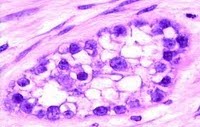
It is a cancer that forms in tissues of the ovary.
There are three types: 1) those of the covering of the ovaries or the epithelial; 2) those of the ovaries themselves or germ cell (this type is seen most often in women under 40) and, 3) those of the connective tissue or sex-cord stroma.

Most ovarian cancers are either ovarian epithelial carcinomas (85-90%) or malignant germ cell tumors (5%)

Estimated New U.S. Cases and Deaths from Ovarian Cancer
New cases - 21, 880 Deaths - 13, 850 (World wide cases 230,000)

RISK FACTORS
*Age
*Family History of Ovarian Cancer
*Being of Eastern European (Ashkenazi) descent
*Having never given birth (or had difficulty doing so)
*Personal History of Breast, Uterine, Colorectal Cancer

*Personal History of Endometriosis
Modified from NCI

From CDC.gov
More white women than other ethnicities get this cancer (but Hispanic women come in at a close second) The average age of diagnosis is 63 and although most women get this over the age of 50 (90% of women are over the age of 40), women of any age can be diagnosed. In depth statistics are here

Symptoms

Early ovarian cancer may not cause obvious symptoms. But, as the cancer grows, symptoms may include:

• Pressure or pain in the abdomen, pelvis, back, or legs

• A swollen or bloated abdomen

• Nausea, indigestion, gas, constipation, or diarrhea

• Feeling very tired all the time


Less common symptoms include:

• Shortness of breath

• Feeling the need to urinate often

• Unusual vaginal bleeding (heavy periods, or bleeding after menopause)


Based upon the presenting symptoms and since they more often are not due to ovarian cancer, women who get diagnosed are often at advanced stages of their disease.


IN THE NEWS.... Two Gene Mutations Found That Mark Hardest-To-Treat Ovarian Cancer - Sept 9, 2010
Finding published in the journal Science and the New England Journal of Medicine (click here for full article)
The genes are for ovarian clear cell carcinoma (10 - 12% of all ovarian cancers) and is one of the most difficult to treat as well as most lethal. It is linked with endometriosis and is resistant to chemotherapy. Two teams of researchers published on this - one from Hopkins and one from the British Columbia Cancer Agency. Dr. Bert Vogelstein and colleagues at Johns Hopkins University in Baltimore named the two new genes as ARID1A and PPP2R1A. (Science abstract here )

Dr. David Huntsman from the British Columbia Cancer Agency published his groups study in New England Journal of Medicine and found that ARID1A was mutated not only in ovarian clear-cell carcinoma but also in a second type of ovarian tumor linked with endometriosis. He found that "Overall, 46 percent of patients with ovarian clear-cell carcinoma and 30 percent of those with endometrioid carcinoma had ... mutations in ARID1A," It was not found in other ovarian tumor types. The ARID1A gene is also a suspect in some cases of lung and breast cancer, Huntsman's team said.
These findings may identify new 'on-off switches' for these tumors, as well as mechanisms of action that aide in developing new medications to treat it.
MECHANISM OF ACTION - The ARID1A gene is involved in a process called chromatin remodeling, which helps squeeze DNA into cells and control when and how it gets "read" to perform a biological function. Mutations in it allow DNA to improperly 'read' and activated, per the Hopkins team.
"Taken together, these data suggest that ARID1A is a classic tumor-suppressor gene," Huntsman's team wrote. These genes, when not mutated, aid in blocking tumor formation -similar to other genes such as BRCA1 and p53.
Currently, since most women are diagnosed with widely spread disease, most (70%) die within five years.
SOURCES: link.reuters.com/nyg52p Science, September 8, 2010 and link.reuters.com/pyg52p

MORE INFO


*HERE NCI Site with information, clinical trials and more

*What You Need To Know About™ (Epithelial) Ovarian Cancer NCI created resource on ovarian cancer

*If you have a hysterectomy, should you get ovaries out to prevent disease? Controversy discussed at CNN report


* Here's a CDC Podcast on Gynecologic Cancers


New England Journal of Medicine, September 8, 2010.


FULL NEJM ARTICLE AVAILABLE AT ARID1A

Thursday, August 18, 2011

Sex and Gender Medicine - A Lens for Evaluating Sociocultural Determinants of Disease


It used to be good enough to be smart - good in science; good at figuring things out. When you only have penicillin or sulfa, then just making the right diagnosis was pretty impressive. But times of have changed - we have PET scans and PCRs; we have minimally invasive surgery and a vast (if not overwhelming array) of medications and interventions at our disposal.

So today our gold standard has migrated past being smart and finding the disease 'in' a patient - now we are expected to influence health outcomes.

When acute injury and infections were a major cause of death (and we had limited tools) we had challenges. Now, most diseases are chronic and the ability to influence runs over a longer timeframe. Diabetes, Obesity, Hypertension, Heart Disease, Cancer - not 'quick in- quick out' challenges and certainly not the easiest to impact on outcomes. Yet, it is do-able.

We just need to get all of the data - scrutinize the biomedical, be clinically and scientifically curious and obtain data about the person in her world. One of the ways we can impact health disparities (and therefore move care closer to excellent for all) is to see the whole picture. The whole person.

In understanding the whole person, we need their story - who lives with them? who helps them? who do they help? what do they think or fear is going on? how do they define a good outcome?
Just today, a short essay on the social history was published in NEJM

Complicated Lives — Taking the Social History  R. Srivastava  N Engl J Med 365:587, August 18, 2011.   I highly recommend that   you read it, as it is written by an Oncologist and gives an interesting perspective on what we need to know to care for patients.  Now worries, it's a quick read!

McGinnis, J.M. 2002;21:78-93
Sociocultural determinants of health issues need to be lenses that we use to evaluate our patients. 
Dr Schroeder from UCSF delivered the Shattuck lecture about this. (We Can Do Better - Improving the Health of American People. Schroeder SA. New England Journal of Medicine. 357(12):1221-8, 2007 Sep 20. ) Access HERE courtesy of Pubmed and NEJM.

As physicians, we need to zoom in and zoom out on the pathophysiology and the life of our patients in order to best understand what is going on and how we can best help them lead healthier lives.

For a review on our discussion about sex and gender health disparities, check out this blog entry - click on Sex and Gender Resources as well as check out our other blog entries.


Culture, Gender, Health
Our second blog is Culture Gender Health and it reviews some of the definitions we discussed. It is available on the left side of the blog


Our third blog is a patient health blog Philadelphia Ujima and is a useful place to find plain language (aka health literacy and culturally appropriate) health education info and resources.


You are invited to suggest topics or even contribute - no advanced computing skills needed!


This blog was created to help your educational experience - let us know what you think!!

Monday, August 8, 2011

The Female Pattern of Heart Disease

Welcome back! Some day, heart disease will not be the biggest killer of people in the U.S. And someday, despite higher risks in men - similar or fewer (rather than more) women will die of heart related deaths.
For this year, I'm trying something a bit different - but I will rely on your feedback to continue with it.
There exists a different way to show material called Prezi. I'm using this as a resource session / lecture review reinforcer to help you 'at a glance' review our time together.

So, here is the link http://prezi.com/hiu-zxeatihs/sex-gender-and-cardiac-disease/
Check it out and let me know if it is useful - these are pretty labor intensive so I need to know if  they are value added or not.

Tuesday, April 19, 2011

Advocating For Patients

Two weeks ago, on April 7th 2011, I attended the Planned Parenthood lobby and rally day in Washington DC. It was my very first real use of the U.S. political system outside of the utilization of my right to vote. I was nervous and (albeit embarrassed to admit) quite under educated about the true politics of “women’s health”. As an undergraduate student who was extremely involved in women’s health and education I used Planned Parenthood many times as a resource for the education and medical health of the women I worked with on campus. Thus, when I saw the flyer for the rally I contacted the coordinator that night to sign up.

In true over-worked, sleep-deprived med student fashion I debated backing out last minute for fear the rally would cut into my precious study time for our upcoming exams. Somehow, however I overcame the “med school mentality” and hopped on a bus the next morning with 30 other PP supporters ready to show Washington how important the Planned Parenthood organization is to this nation.

PP coordinators had packed the day full of lobby’s with Pennsylvanian senators including an all day rally on the national mall lawn. There were people from all walks of life who had come out to support the cause. It was truly inspiring to see the medley of medical providers, little children, senators, Catholics, atheists, mothers, and fathers all out in support of women’s health.


During the lobby sessions I heard both sides of the PP budget cut battle. Senators who supported PP were happy to see us and could not stop thanking us for being there for this important moment in the history of women’s health. Senators who opposed PP, however, showed sentiments at both ends of the spectrum, from understanding and speculation of facts about the organization to total disinterest.

While not every lobby session was able to convert a senator, there were plenty of lives changed by the day’s activities. I met a man at the rally who had come all the way from Tennessee, missing school and work, to share his voice with congress and keep his sister and future daughters safe and reproductively healthy. I can’t tell you how many locals stopped to talk to him as they were riding by on their bicycles and how many women came up to thank him for coming.


This brings to light the point that, while we as health care professionals do work extremely hard every day to protect the health of our patients in our offices and on the wards, there are other important educational and health promoting opportunities out there that can make us even better at what we do, so we should choose to engage in them.

Sometimes it takes being on the front lines of the fight to really realize the true meaning of why were fighting at all.

For more info on Planned Parenthood/how to get involved CLICK HERE
For info regarding the budget cuts involving PP visits CLICK HERE

Blog post by Nicole Perry, MS II

Monday, March 7, 2011

Reassurance

What kind of care do women in college need? They need acute care for viral infections, skin problems, and minor sports-related injuries. They need gynecological care for STD checks, vaginitis, and annual exams. They need preventative care for nutrition, exercise, and safe health practices. But perhaps most of all, what they need (and maybe what they want without knowing it) is reassurance. These are 18-22 year olds, most of them away from home for the first time, and many of them taking care of their health for the first time. Much of what we do in the clinic involves counseling, support, and letting them know that we are there for them and that they’re going to be okay.


Take for example a typical College health patient -  a young woman came who comes in extremely anxious. She had just experienced an asthma attack in the student center in which she had had such a severe coughing fit that she ended up vomiting. This embarrassing experience accompanied by her fear over being short of breath caused a panic-like state. After being brought into an exam room and we began by telling her everything was going to be okay. The mere comfort of being in the clinic with myself and the nurses immediately calmed her down and we were able to do a complete exam and take the measures needed to help her out. In addition, we discovered in the history that she had stopped taking her controller asthma medications several days ago and was in the midst of an upper respiratory infeciton. We spent quite a bit of time counseling her on the danger of stopping her daily meds. We also instructed her on actions that she, as an asthmatic needed to be taking in her dorm room and in her daily life to prevent asthma attacks during upper respiratory infections. Finally, we scheduled her for a follow-up appointment in the next 2-3 days (another luxury of college health care!). She left breathing normally, her color returned, and with many thanks to us. It was a satisfying visit not only because we helped stablize her acute condition but because we were able to counsel her on measures that will hopefully stay with her throughout her life. In addition, we were able to establish a point of care and schedule regular follow-up so that we could track her progress and make sure she is doing well. And finally, we were able offer her reassurance that she would be okay and would be well cared for.


College tries to offer young people a home away from home. But when a young woman feels ill or injured or scared, she wants to be with people who will care for her. Short of parents, the college health clinic fills the void of a caretaker. And in addition, we try to prepare them for taking care of themselves, teach them to take their medications, to take care of themselves, and to see a doctor when they need to. Most of all, we tell them that everything is going to be okay.


Blog entry by Anna Booth, MSIV

Wednesday, January 5, 2011

Resources from Sex and Gender Health Disparities IM Grand Rounds Jan 5, 2011

Hi,
Thanks for joining me at Grand Rounds. As promised here's the resource listing I mentioned. I've listed the 'what can I use right now?" up front, right after tips to optimize your online blog experience. I included a listing of other resources on health disparities, sex and gender and literacy as well.  Ana Nùñez, MD Associate Professor of Medicine


PART I   Online Information from The Women's Health Education Program and the Philadelphia UJIMA Team
   GENERAL ONLINE SEARCH TIPS:
How To Get The Most Out of Your Search Here Click on a subject or search for a topic. Optimize your experience by clicking on hyperlinked objects that have articles, tools, resources or useful links.

  Interested in contributing?   Let us know! Don't be intimidated, the skills you need are  being able to create a Word document and to attach hyperlinks. If you are interested in more than that, we can help you. Call or email us!

·      Women’s Health Info Online Resources  (you are here now!) – Target audience: trainees and clinicians. It is available at http://whepducom.blogspot.com
·      Consumer Health Online Info Target audience: patients and lay public. It is available at http://philadelphiaujima.blogspot.com/ (or from left side bar on this page)
·      Philadelphia Ujima website – This is the location of Ujima Collaborative Project and has numerous open access resources, materials and information. It is available at http://www.philadelphiaujima.com/ 
·     Cross Cultural Effectiveness: The Gender Lens – Target audience: faculty; educator and other interested. The site is located here http://culturegenderhealth.blogspot.com

PART II  RIGHT NOW RESOURCES      


STAY TUNED!! COMING IN FEBRUARY – New free online videos for motivational interviewing from Ileana Pina, MD at Case Western Reserve as part of the Heart Truth NHBLI Initiative
·      Not mentioned, but other local resources is our School of Public Health – additionally training will impart health services and community engagement tools into your skillset if you are interested in HSR as a way to making your impact on health care.
parities
PART III   SELECTED RESOURCE LISTING  – For Health Disparities; Sex and Gender; and Health Services Research
Scope of Health Disparities in the US.
Schoen, C., Doty, M.,Collins, S., and Holmgren. Insured But Not Protected: How Many Adults Are Underinsured? A. Health Affairs Web Exclusive, June 14, 2005 W5-289W5-302
Krisberg, K. Millions of Americans Suffer From Low Health Literacy. Nations Health. American Public Health Association. 2004;34(6) 
Blacksher, E. Healthcare disparities: the salience of social class. Camb Q Healthc Ethics. 2008 Spring;17(2):143-53.
Lurie N. Health Disparities — Less Talk, More Action. N Engl J Med 2005; 353:727- 729
Heart Health and Women

Gender and Ethnic Issues in Heart Health – video and resources here
Sociocultural Determinants of Health and Healthy People 2020
Women’s Health Research
Women’s Health Report Card by State available at here
Institute of Medicine (2010) Future Directions for the National Healthcare Quality and Disparities Reports. National Academy Press, Washington DC.
Health Services Research
Institute of Medicine (1995).  Health Services Research: Training and Workforce Issues (Eds. Field MJ, Tranquada RE, Feasley JC). National Academy Press, Washington DC.
Lohr KN, Steinwachs D.  Health services research: an evolving definition of the field.  Health Serv Res 2002;37(1):7-9.
UC Berkeley School of Public Health Strategic Plan 2003-2007
Community Participatory Research
            Kemmis S, McTaggart R. 2000. Participatory action research. In: Handbook of Qualitative   
            Research (Denzin NK, Lincoln YS, eds). Thousand Oaks, CA:Sage, 567–605.
Heron J, Reason P. 2001. The practice of cooperative inquiry: research “with” rather than “on” people. In: Handbook of Action Research: Participative Inquiry and Practice (Reason P, Bradbury H, eds). Thousand Oaks, CA:Sage, 179–188.
Gender Informed Health and Analyses
Health Canada. Health Canada’s Gender-based analysis policy. Ottawa:Minister of Public Works, 2000
Integrating Gender Perspectives in the work of WHO, WHO Gender Policy, 2002 
Gender Analysis Toolkit from Gender Evaluation Methodology for Internet and ICTs available here
Wagner Chronic Disease Model
Wagner EH. Chronic disease management: What will it take to improve care for chronic illness? Effective Clinical Practice. 1998;1(1):2-4.]
Health Literacy
Institute of Medicine (2010) Safe Use Initiative and Health Literacy: A Workshop. National Academy Press. Washington, DC.
National Literacy Survey. 1993
National Assessment of Adult Literacy (NAAL) from the IES NAational Center for Education Statistics of the US Dept of Education Institute for Education Sciences 2003 located here
Rothman, RL, Housam, R, Weiss, H, Davis, D, Gregory, R, Gebretsadik, T, Shintani, A, Elasy, TA. Patient understanding of food labels: the role of literacy and numeracy. Am J Prev Med, 31(5), 391-8, 2006.